









Attend USB4 and USB-C connectors with up to IP68 protection
Attend have strengthened their lineup of USB connectors to USB-C, including USB4 versions. We've made sure to add these to our product portfolio as the increased IP rating brings a lot more options, not only for portable devices but for many industrial applications, too.
We've compiled a quick overview of the current USB4/USB-C landscape and included some practical tips for selecting the right connector for your application. But before we dive deeper, let's cover the essentials.
What is the USB4 specification?
The USB4 (Universal Serial Bus Generation 4) specification builds upon USB 3.2 and USB 2.0 and is based on the Thunderbolt protocol.
It is all about multi-protocol communication, meaning a single connector allows for USB 3.x, DisplayPort, and PCI Express communication, and it can also power the connected device. As a result, the USB4 specification always incorporates USB PD (Power Delivery) capability. However, the connector is always USB-C type.
What unique advantages does USB4 offer?
USB4 lets you connect multiple peripherals to a portable device or computer using just one type of cable, all while delivering high data transfer speeds.
Top new additions to Attend's USB-C connectors:
We've introduced several waterproof USB Type-C connectors to the USB and Fire Wire (IEEE 1394) product group from Attend. They combine high-speed data performance with robust protection meeting IP67 up to IP68 standards, making them perfect for industrial, automotive, and portable applications.
We also considered various mounting styles for your projects when making our selections.
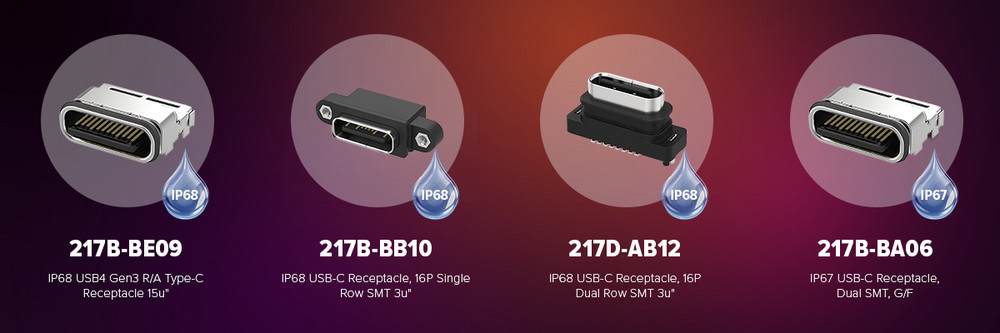
- 217B-BE09 – USB-C, 24 pins, SMD, IP68, Gen3 USB4, 40 Gbps, 30 V/5 A
- 217B-BB10 – USB-C, 16 pins, SMD, IP68, USB 2.0, 20 V/5 A, screw-mounted
- 217D-AB12 – USB-C, 16 pins, SMD, IP68, USB 2.0, 20 V/5 A, vertical
- 217B-BA06 – USB-C, 24 pins, SMD, IP67, USB 3, 10 Gbps, 20 V/3 A, up to 105 °C
- US-CPCP-12002 – USB cable for 217B-BB10, USB 3.1, 1,2 m length, screw-mounted
We've added Attend USB-C connectors with both IP67 and IP68 protection to our product range. Selected products are immediately available for your projects. We'll be happy to arrange others for you to order under excellent conditions directly from the manufacturer.
Try a sample for your project
Need to test a component during development? Don’t hesitate to get in touch, or fill out the form below the article and we’ll be happy to provide a sample for your project.
Tips on choosing the right USB connector for your application
Choosing a USB connector based on speed and device purpose:
Before you select the right USB connector, it's smart to know the answers to the following questions.
- Do we only want to charge a portable device and use the USB PD protocol?
In this case, a 6-pin USB-C connector is sufficient. This is typically used in portable device chargers. The key parameters here will be the voltage rating and current rating.
- Do we want to charge a portable device, use the USB PD protocol, but also communicate at speeds up to USB 2.0?
For this, you'll need a USB connector with 16 pins, such as the 217B-BB10 or 217D-AB12.


- Do we want to charge a portable device, use the USB PD protocol, but also communicate even faster?
The selection is a bit more complex here. However, you definitely need a connector with 24 pins, like the 217B-BE09 or 217B-BA06. Next, we‘ll also factor in parameters like rated voltage and current for charging, along with the maximum data transfer rate you need for communication.

Connector USB 4 Gen3 C F 24P SMD Angled 2-row IP68
1 pcs+ 3,1153 €
5 pcs+ 2,7701 €
20 pcs+ 2,5612 €
100 pcs+ 2,3796 €
200 pcs+ 2,2706 €
800 pcs+ 2,1344 €
If a high transfer speed is critical for your connector choice, consider looking at the 217B-BE09 from ATTEND, which is defined as a USB4 Gen3 connector for data transfer up to 40 Gbps. But what exactly does that mean in real terms, and how should we properly understand it?
Did you know?
If a manufacturer specifies that a USB Gen3 (Generation 3) connector is intended for a maximum data transfer rate of 40 Gbps, this corresponds to a USB4 Gen 3x2 configuration. The 'x2' means that two differential pairs of conductors are used.
| However, the 40 Gbps value is not the maximum transfer rate of a single differential pair. Instead, it's the total aggregated maximum transfer rate in a given direction, achieved by using multiple differential pairs.
|
In this specific example, the rule is 2×20 Gbps=40 Gbps. Therefore, the transfer rate for a single differential pair is 20 Gbps.


Choosing a USB connector based on lifespan:
Generally, USB Type-C connectors are designed for a high number of connect and disconnect cycles, most often 1 000 to 10 000 cycles. For comparison, the typical cycle count for WTB (Wire-to-Board) connectors is 50 to 100.
Choosing a USB connector based on environmental resistance:
Just like with the previous points, we'll find the best solution by answering the following questions.
- Do we need a sealed USB-C connector with IP67 or IP68 protection?
A device sitting freely on a desk usually doesn't need special protection around the connector against dust or moisture ingress. However, a device carried in a pocket is exposed to dusty environments or occasional dampness, and will definitely need a connector with higher resistance to dust and water.
If you go this route, you must ensure that the device enclosure itself is also precisely designed to meet the same high IP protection rating.
- What should the gold plating thickness be for the surface finish of USB-C connectors?
USB-C connectors aren't specifically made for aggressive industrial environments. Even so, portable devices can be carried in pockets, get damp in a bag, or even have an acidic drink or solution spill on them while you're working.
In general, there are two common types of gold surface finish for USB-C connectors:
- Flash Gold – Contacts with this finish have a very thin layer of gold, so they aren't truly gold-plated. The thickness of the nickel layer underneath is more important here. It is most often 50 u”.
- Gold – If the contact manufacturer considers their contacts genuinely gold-plated, they will have invested significant effort and money, and will subsequently state the gold thickness on the contacts. The most common values for gold thickness on plated contacts range from 3 u” to 50 u”.
What is the right gold thickness for USB-C connectors?
As you might have guessed, there's no single, clear answer to this question.
The gold thickness of a plated contact depends on several factors. If a USB-C connector is used in portable devices where it's frequently plugged in and unplugged, the likelihood of an oxidised layer forming is lower.
Where the contacts don't directly touch, the contact should be springy, sufficiently smooth, and the plating layer should be uniform enough not to wear down the plastic guide the contact moves in. Gold-plated contacts, meaning the Gold finish, satisfy all these requirements, but the Flash Gold finish does not.
If the USB-C connector is only used occasionally, for example, as a service connector for device FW (firmware) updates), a gold-plated contact is still important, but the gold thickness doesn't need to be extremely high.
Want to learn more about USB connectors?
You can find helpful information on USB4 and USB-Type C, as well as logo marking based on USB-C features, in the linked resources. You can also find a clear table and even more information on USB and USB4 on Wikipedia.
You can find the pinout details and links to other Attend USB-C connectors in our previous article, "USB-C Attend Connector for PCB with IP68 Reliably Protects Your Application".
A practical table on Power Delivery (PD) modes is available in the article "Three Things You Should Know About USB-C".
Your feedback helps us create truly useful content for our readers. Appreciate the above information with an imaginary contribution for this article.
If you have any questions or comments, please don't hesitate to contact us. Thanks again for your time and trust.
Interested in more information about Attend products or need technical advice on choosing the right product? Have any other questions or requests? Reach out, and we’ll be happy to assist!
Try a sample for your project
Need to test a component during development? Don’t hesitate to get in touch, and we’ll be happy to provide a sample for your project. We review each request individually, so please share a brief overview of your project with us in the form below.
Note: Samples are provided for development projects only, not for individual personal use.
Thank you for understanding.
Do you like our articles? Do not miss any of them! You do not have to worry about anything, we will arrange delivery to you.


