




Modern automation, robotics, and smart industrial setups live and die by how well they map their environment. Whether you are developing domestic helper robots, commercial service bots, autonomous mobile robots (AMRs), automated guided vehicles (AGVs), or advanced industrial safety barriers, capturing highly accurate distance measurements in real time is non-negotiable for reliable deployment.
This is where YDLidar steps in. As a dedicated specialist in intelligent sensing, they have spent years developing innovative, robust solutions tailored to the strict demands of modern automation.
Overview of YDLidar lidars
Lidar, which traditionally stands for light detection and ranging (or, more recently, laser imaging, detection, and ranging), calculates the distance to surrounding objects by emitting light and measuring its return. This can be done either across a single 2D plane or in a 3D volume. The resulting stream of coordinates is compiled into a point cloud, which serves as the primary spatial map for vacuum cleaners, warehouse AGVs, and autonomous service robots.
YDLidar offers robust 2D lidars operating on either optical triangulation or Time-of-Flight (ToF) principles alongside specialised depth cameras. These compact depth-sensing units package an infrared camera, a structured light projector, and a dedicated distance processor into a single, integrated solution.

The projected light pattern consists of randomly sized and positioned spots. To calculate depth, the distance processor compares the pixel deviation in the captured camera images against a pre-calibrated reference image of a flat surface at a known distance. By evaluating these pixel shifts, the processor quickly calculates the exact distance to surrounding objects.

Specifications of YDLidar lidars

Reading between the lines of a lidar datasheet
When choosing a lidar sensor, it is easy to get lost in the numbers. Understanding what these specifications actually mean during operation is key to selecting the right model for your project.
- Scan frequency versus sampling rate = While scan frequency refers to how fast the internal motor spins (measured in Hz or revolutions per second), sampling rate (or measuring frequency) is the total number of distance measurements the sensor takes every second. As an example, if we look at the compact T-mini PLUS, it operates with a sampling rate of 4000Hz and a typical scan frequency of 10Hz. This means the lidar captures exactly 400 distinct data points across its 360° sweep.
- Ambient light tolerance - This parameter tells you how much background light the receiver can tolerate before the signal-to-noise ratio degrades. While the lidar will still run under direct sunlight or bright industrial lighting, you must expect a shorter reliable sensing range because the ambient light partially blinds the receiver.
- Field of view - While most rotating lidars typically offer a full 360° horizontal field of view (FoV), there are specialized exceptions. For instance, the TEA lidar is designed with a 300° scanning window. If you need a solid-state solution with no moving external parts, models like the GS2-T850 (T808) and the GS5 offer fixed horizontal views of 104° and 80° respectively. Meanwhile, a standard depth camera HPC60 provides a wide field of view measuring 74° horizontally by 59° vertically, which is highly effective for close-range 3D obstacle avoidance.
Measurement accuracy

Putting lidar to work: Real-world application scenarios
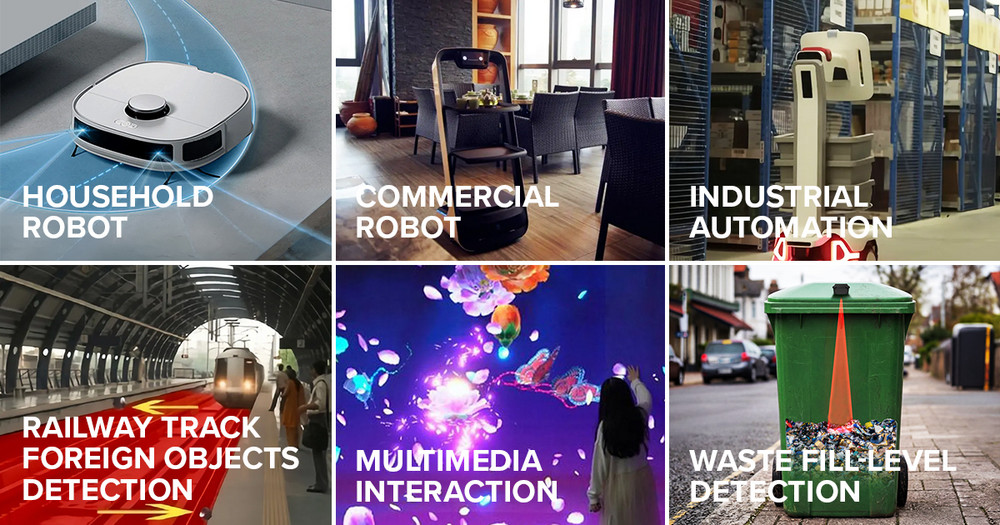
- Household robots - T-mini PLUS + GS2 or GS5
- Commercial service robots - TG15, TG30, TG50 + HP60C
- Warehouse robots, unmanned forklifts, AGV (automatic guided vehicles), AMR (autonomous mobile robots) - TEA, TG30, TG50
- Multimedia interaction - TEA, TIA-H
- Railway track foreign objects detection - TG15, TG30
Waste fill-level detection - SDM15
ToF Lidars

Triangulation Lidars

Software support and integration
Getting your lidars up and running should not be a struggle. Fortunately, YDLidar provides robust out-of-the-box support for both ROS and ROS2 (Robot Operating System), which are the industry standards for robotic software development.
To integrate a sensor with your Linux distribution, simply download the model-specific SDK and driver package from the official YDLidar repository, compile and install them on your system. More details can be found in the user manual.
We have carefully selected YDLIDAR's most capable and versatile distance sensors and added them directly to our product range because they offer the best balance of performance, reliability, and cost-effectiveness for next-generation designs. You can browse our complete portfolio and download full technical datasheets directly from our website.
Need a model that is not currently listed? We can easily source other lidars for you on request with short lead times and highly favourable terms. Looking to dive deeper? You can find plenty of valuable insights and context in our previous articles on this topic.
Your feedback helps us create truly useful content for our readers. Appreciate the above information with an imaginary contribution for this article.
If you have any questions or comments, please don't hesitate to contact us. Thanks again for your time and trust.
Interested in more information about YDLidar products or need technical advice on choosing the right product? Have any other questions or requests? Fill out the form below, and we’ll be happy to help!
Do you like our articles? Do not miss any of them! You do not have to worry about anything, we will arrange delivery to you.


