Notice
You are currently browsing the website for customers from United Kingdom. We recommend switching to the United States version of the site, optimized for your region.


Photovoltaic systems and energy storage operate with high DC voltages and large currents, often outdoors and without interruption. A fault in a connection or in the protection here means lost generation or a risk of fire. That is why the rated DC voltage, current capacity, environmental resistance and accurate measurement are decisive when choosing components.
We have arranged the range according to the path the energy takes: from the solar panel through cabling, power electronics and protection to metering and communication. At the end you will also find instruments for testing and servicing power systems.

Monocrystalline Solarfam solar panels with 20 W and 30 W output are designed for off-grid systems, monitoring stations and battery charging. The energy flow into the battery is managed by Solarfam MPPT charge controllers, for example a type for 12 V and 24 V systems with a current of 15 A.
Panels are connected with Stäubli MC4 connectors rated for 1000 V with IP67 protection, in versions for conductor cross-sections of 1.5 to 2.5 mm² and 4 to 6 mm². They are matched by the Stäubli FLEX-SOL-EVO-TX photovoltaic cable with a cross-section of 2.5 mm² and a current capacity of 42 A. Battery storage systems can be connected with Phoenix Contact BPC connectors for 120 mm² conductors.
Inverters and chargers are built on Diotec IGBT transistors, for example types for 650 V and 75 A in a TO-247-4 package or for 1350 V and 40 A. For switching DC circuits, there are relays for 450 V DC and 20 A or 30 A with a 12 V DC coil.
Circuits are protected by Schurter and ESKA fuse holders, from panel-mount types for 5 × 20 mm fuses to a DIN rail holder. The latter is designed for 10.3 × 38 mm fuses, 1000 V DC and 25 A. Schurter also supplies thermal circuit breakers with rocker actuators, power line filters and a 130 A SMD thermal fuse. Heat is removed from inverter cabinets by ebm-papst centrifugal fans with airflow of up to 735 m³/h.
DIN rail power supplies from TRACOPOWER and Myrra are designed for control electronics, communication and metering. The 240 W types are available with 12, 24 and 48 V output voltages. If the mains fails, a 960 W DIN rail DC UPS and 12 V lead-acid backup batteries with 12 Ah or 38 Ah capacity take over.
Generation and consumption are recorded by Finder energy meters with MID certification, single-phase for 40 A and three-phase for 80 A with two tariffs and an M-Bus interface. Finder also offers an energy analyser for TRMS measurement of AC and DC current and a Modbus TCP to Modbus RTU converter. Data is sent remotely by Quectel LTE modules in miniPCIe format, including a type supporting LTE Cat M1, NB-IoT and EGPRS.
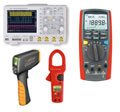
Development of inverters and chargers can be verified with Voltcraft, Rohde & Schwarz and Diametral bench-top power supplies. For higher power, there are rack-mount power supplies and electronic loads from Elektro-Automatik and TDK-Lambda, for example a 0 to 10 V, 500 A supply with 5000 W. During installation and maintenance, Teledyne FLIR and UNI-T thermal imaging cameras with a range up to 400 °C reveal overheated connections. Measurements on PV systems can be made with a CAT III 1000 V multimeter.





We will help you put together components from the panel to metering and choose instruments for testing. Samples are available before ordering for selected products. Describe your system's layout and power and we will prepare a suitable proposal.