

Our products by application: Medical & Healthcare

What a medical device designer has to keep in mind
A device at the patient's bedside must remain safe even under fault conditions, must not interfere with other equipment and usually runs without a break. Staff clean it with disinfectants and expect unambiguous feedback from the controls. Component selection therefore depends on power supply isolation, low leakage current, measurement accuracy, wipeable surfaces and quiet operation.
The topics follow the path from the mains socket to the patient: power and mains input, breathing and gas measurement, control, display, computing power and cooling. The components are used in ventilators, imaging equipment, laboratory analysers, patient monitors, incubators, adjustable beds and nurse call systems.
What you will learn from this page
- Which power supplies meet 2 × MOPP requirements?
- Which sensors measure airflow and oxygen concentration?
- How do you operate a device when the doctor has both hands busy?
Need help choosing the right solution for your application?

Ventilator systems

Imaging


Laboratory analyzers

Patient monitoring


Incubators and Operating rooms


Wellness
Our products offer (grouped by category)






Electronic components for medical technology
Medical power supplies
Devices are fitted with TDK-Lambda CUS-M series open frame AC/DC power supplies. They provide 2 × MOPP isolation between primary and secondary and are suitable for BF type equipment. Power ratings range from 30 W to 300 W with a 500 W peak. For PCB mounting, the encapsulated TRACOPOWER TMW module offers IP68 protection and 2 × MOPP certification to IEC 60601-1.
External power and mains input
Mobile devices are powered by FRIWO DT50 desktop adapters for medical applications with 50 W output and an IEC C8 inlet. The mains cord enters the device housing via Schurter power entry modules with a C14 inlet and EMC filter. The 5180 series includes variants with 1 MOPP isolation, while the medical version of the DD14 combines filter, switch and fuse holder.
Respiratory technology and gas analysis
Sensirion SFM3xxx mass flow meters with a ±250 slm range and I2C interface are designed for ventilators and other respiratory devices. Oxygen in the breathing mixture is measured by an SGX Sensortech electrochemical sensor across the full 0 to 100 % range. The gas sensors range also includes a Sensirion formaldehyde sensor for laboratories and a Nissha FIS ozone module. For liquid dosing, Sensirion SLF3S flow meters cover 2 or 40 ml/min, with USB test kits for quick evaluation.
Hands-free control
During a procedure, when the doctor has both hands busy, a pedal triggers the device function. Marquardt offers SPDT foot switches rated for 250 V AC. Front panels can use MEC pushbuttons with a defined actuation force and waterproof Controlmec keypads. Stainless steel pushbuttons with LED indication come from Schurter.
Displays and bedside operation
Where frequent disinfection is required, the waterproof Lexsystem panel PC in a stainless steel enclosure is a good fit. It has a 19" capacitive touch display and an Intel Atom x6413E processor. Smaller devices show readings on 1.54" and 2.42" Winstar OLED modules or on a Bolymin 16 × 2 character OLED display. Bedside electronics are protected by a Hammond enclosure made of 304 steel with IP66 rating.
Computing power for imaging and analysis
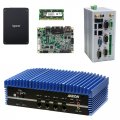
Image processing and analysis of laboratory instrument data are handled by an AAEON box PC with PCIe expansion for an NVIDIA Tesla T4 graphics card. Your own control board design is sped up by a MYIR SoM with the i.MX 9352 chip, operating from -40 to 85 °C. The device connects wirelessly via the Lantronix xPico 250 for Wi-Fi and Bluetooth or via a Quectel NB-IoT module. Staff log in with a card on the Elatec TWN4 Slim reader.
Cooling and backup power
In monitors and analysers that stand next to the patient, noise level matters. Sunon supplies Silent 92 × 25 mm axial fans at 17.7 dBA, and ebm-papst a miniature 40 × 10 mm type for 24 V DC. A FANSO AA lithium cell keeps the clock and settings during a mains outage.
Our products offer (grouped by manufacturer)


Need help choosing the right solution for your application?
Recommendations for medical device design
- Patient protection. IEC 60601-1 distinguishes between means of operator protection (MOOP) and means of patient protection (MOPP). For parts in contact with the patient, plan for 2 × MOPP isolation and leakage current limited according to type B, BF or CF.
- Electromagnetic compatibility. Medical devices are assessed under IEC 60601-1-2. Address mains filtering and shielding as early as the first prototype.
- Alarms and signalling. Requirements for audible and visual alarms are defined in IEC 60601-1-8. For loud signalling, piezo buzzers with driver are suitable, such as the Sonitron type with 98 dB and IP67 rating.
- Supply changes. Medical devices are subject to Regulation (EU) 2017/745. Any component substitution may require a new assessment, so check long-term availability and follow manufacturers' change notifications.
Advice on medical components
Our technical team will help you choose a power supply, sensor or control element. Samples of selected products are available for verification in a functional model. Send us a description of your medical device and we will propose a suitable solution.


