


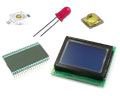







When manufacturing semiconductors, achieving absolute uniformity is practically impossible. During the production process, microscopic variations in layer thickness, material composition, and temperature occur across the wafer - the silicon substrate or semiconductor slice where all the chips are fabricated. This directly affects the performance and characteristics of the individual LED chips.
| To counter this, leading optoelectronics manufacturers like Kingbright use a process called LED binning. This post-production sorting method groups LEDs with highly similar characteristics together, ensuring visual consistency across your production runs. |
General binning industry standards
Across the optoelectronics industry, manufacturers categorise LEDs based on three primary parameters.
1. Luminous flux or intensity
- Monochromatic / Indicator LEDs – These components are typically sorted by luminous intensity measured in millicandelas (mcd), which dictates how bright the LED appears from a specific viewing angle.
- Power LEDs – These are sorted by luminous flux measured in lumens (lm), evaluating the total light output across all directions.
2. Colour characterisation
- Single-color LEDs – These are grouped by their dominant wavelength. While peak wavelength represents the highest spectral brightness, the dominant wavelength is what the human eye actually perceives.
- White LEDs – Because white light does not have a single wavelength, these components are binned using chromaticity coordinates (x,y) mapped onto the CIE 1931 chromaticity diagram.
3. Electrical characteristics
- Forward voltage (Vf): LEDs are sorted in fractions of a volt.
| If forward voltage varies significantly across components connected in parallel, the current will be distributed unevenly. This causes some LEDs to overheat and degrade prematurely, while others remain dim. |
Kingbright LED sorting: binning and sub-binning
As a renowned manufacturer of LED (light emitting diode) components, Kingbright maintains strict production and sorting standards, outlining precise tolerances in their data sheets.
Tight tolerances
The standard sorting tolerances for Kingbright LEDs are highly precise:
- Dominant wavelength (Lambda_D): Sorted within a tolerance of ±1 nm
- Forward voltage (Vf): Sorted within a tolerance of ±0,1 V
- Luminous intensity (I_v): Sorted with a tolerance of ± 15 %
Bin marking
Instead of supplying LEDs in wide tolerance bands, Kingbright splits its product lines into specific sorting categories based on application requirements.
| This tight segmentation ensures that an entire batch of LEDs shares virtually identical parameters. |

For full details on how individual bins are classified, see Kingbright's attached PDF technical documentation.
Real-world implications of LED binning
The danger of underdriving your LEDs:
If you select a Kingbright LED binned at 20 mA but run it at 2 mA via PWM or a resistor to save power or reduce brightness, you effectively invalidate the manufacturer's binning metrics.
Operating monochromatic LEDs at exceptionally low currents causes two distinct issues:
- Non-linear drop in intensity with huge component-to-component variance
- Spectral shift in colour wavelength.
Mixing reels on the PCB assembly line
Electronics Manufacturing Services (EMS) providers must ensure that a single production run utilises LED reels with the exact same bin code. Mixing a "Bin Q" reel with a "Bin S" reel on the pick-and-place machine leads to an uneven, patchy appearance across LED displays, panels, or matrices.
1. Non-linear drop and the 10 % misconception
On paper, you might expect that cutting the current to 10 % of its rated value from 20 mA to 2 mA would yield 10 % of the light output. In reality, the output drops much further due to sub-linear electron behaviour within the semiconductor crystal.
Martin Brestovič, Product Manager at SOS electronic, explains the phenomenon: "Look at it this way: if you populate a board with ten 20 mA LEDs and run them all at 20 mA, they will look completely flawless and uniform. But the moment you try to dim them down to 2 mA using standard analog DC current, you run into trouble. Those tiny, random microscopic variations and crystal defects between the individual chips suddenly take centre stage. You'll get one LED that manages to hold onto 8% of its original brightness, while the one right next to it plummets and only gives you 4%. Before you know it, a display that looked perfect at full power suddenly looks completely patchy and inconsistent."
To address this issue, Kingbright manufactures dedicated low-power LEDs binned at 2 mA. Take the L-7104SURDK and the L-7104LSURDK for comparison. They are technically identical, but they are binned at entirely different currents. For applications where maximum brightness is not required, these low-power LEDs are a much safer bet.
Mitigating dimming issues with PWM
When you need to dim a standard 20 mA LED to the equivalent of 2 mA without dealing with shifts in intensity or colour, analogue dimming is best avoided. A far more reliable approach is Pulse-Width Modulation (PWM).
PWM rapidly switches the LED on and off. If you keep the frequency above 100 – 150 Hz, the human eye cannot detect any flickering. Crucially, during the "on" pulse, the LED receives its ideal, datasheet-rated current. This ensures the component always operates under the optimal conditions in which it was binned. To achieve a 2 mA brightness equivalent, you simply set the PWM duty cycle to 10 %.

2. Wavelength shift
Monochromatic LEDs driven at low currents also exhibit noticeable shifts in colour.
- InGaN LEDs (true green, cyan, blue): Dropping the current reduces internal electric field screening. Consequently, a true green LED run at 2 mA can experience a blue shift of 3 to 6 nm, making it look distinctly blue-green.
- AlGaInP LEDs (red, orange, yellow): These materials are less prone to major wavelength shifts but are highly temperature-sensitive. Lower current decreases the junction temperature, which can trigger a subtle red shift.
Decoding Kingbright LED reel labels
Beyond the standard part number, such as KPT-3216 ZGC, the reel label features a second line containing a three-part alphanumeric code, like "V2E". This string effectively summarises the exact sorting characteristics of the entire reel.
Let us break down how this "V2E" code works for a true green InGaN SMD LED KPT-3216 ZGC, tested at a standard If = 20 mA at 25 °C.

Position 1: Luminous intensity bin ("V")
The first character tells you exactly where the reel sits in terms of brightness. In this example, the letter "V" maps directly to Kingbright's specific selection code for super bright LED matrix.
- Bin code range: 1 200 mcd to 1 800 mcd
- Factory tolerance: ± 15 %
- Practical impact: If an operator accidentally mixes this reel with an "R" binned reel (380 – 550 mcd), one half of your final display panel will end up nearly three times brighter than the other.
Position 2: Dominant wavelength ("2")
The second character defines the perceived colour hue. For an InGaN true green chip, the number "2" restricts the dominant wavelength to a precise 5 nm window.
- Bin code range: 520 nm to 525 nm
- Factory tolerance: ± 1 nm
- Practical impact: The human eye easily spots a colour mismatch if green shifts by more than 5 nm. By locking your assembly line down to bin "2", you guarantee visual harmony across every single production unit.
Position 3: Forward voltage ("E")
The final letter indicates the forward voltage required at the test current. Kingbright groups these into tight 0,1 V steps to make matching easy.

The letter "E" represents:
- Bin code range: 3,1 V to 3,2 V
- Factory tolerance: ± 0,1 V
- Practical impact: This is critical if you are designing multi-LED arrays without independent current controllers. Pairing an "E" bin (3,1 V to 3,2 V) with a "D" bin (3,0 V to 3,1 V) in a parallel circuit would cause the "D" bin LEDs to draw more current, leading to localized overheating and rapid degradation.
As for ordering specific bins, Martin Brestovič adds a realistic note on supply chain logistics: "Customers often ask me if they can just order reels with one specific bin code. In very rare cases, we can check exactly what batches the manufacturer has sitting in their warehouse, but as a general rule across the global optoelectronics industry, ordering a pre-selected bin just isn't standard practice. That said, Kingbright guarantees that every single reel is thoroughly sorted, and they limit the variations between reels to safeguard the visual consistency of your end application."
We offer a comprehensive portfolio of optoelectronic components across our LED range. As an official Kingbright distributor and a member of the Conrad Group, we can help you choose the right component for your design and ensure a stable, long-term supply for your production. Get in touch with your requirements, and our team will be happy to assist you with the LED selection.
If you want to dig deeper into optoelectronics design, we’ve covered plenty of other practical setups in our LED articles.
Your feedback helps us create truly useful content for our readers. Appreciate the above information with an imaginary contribution for this article.
If you have any questions or comments, please don't hesitate to contact us. Thanks again for your time and trust.
Interested in more information about Kingbright products or need technical advice on choosing the right product? Have any other questions or requests? Fill out the form below, and we’ll be happy to help!
Do you like our articles? Do not miss any of them! You do not have to worry about anything, we will arrange delivery to you.


